Ghana Budget Review – 2027 Budget
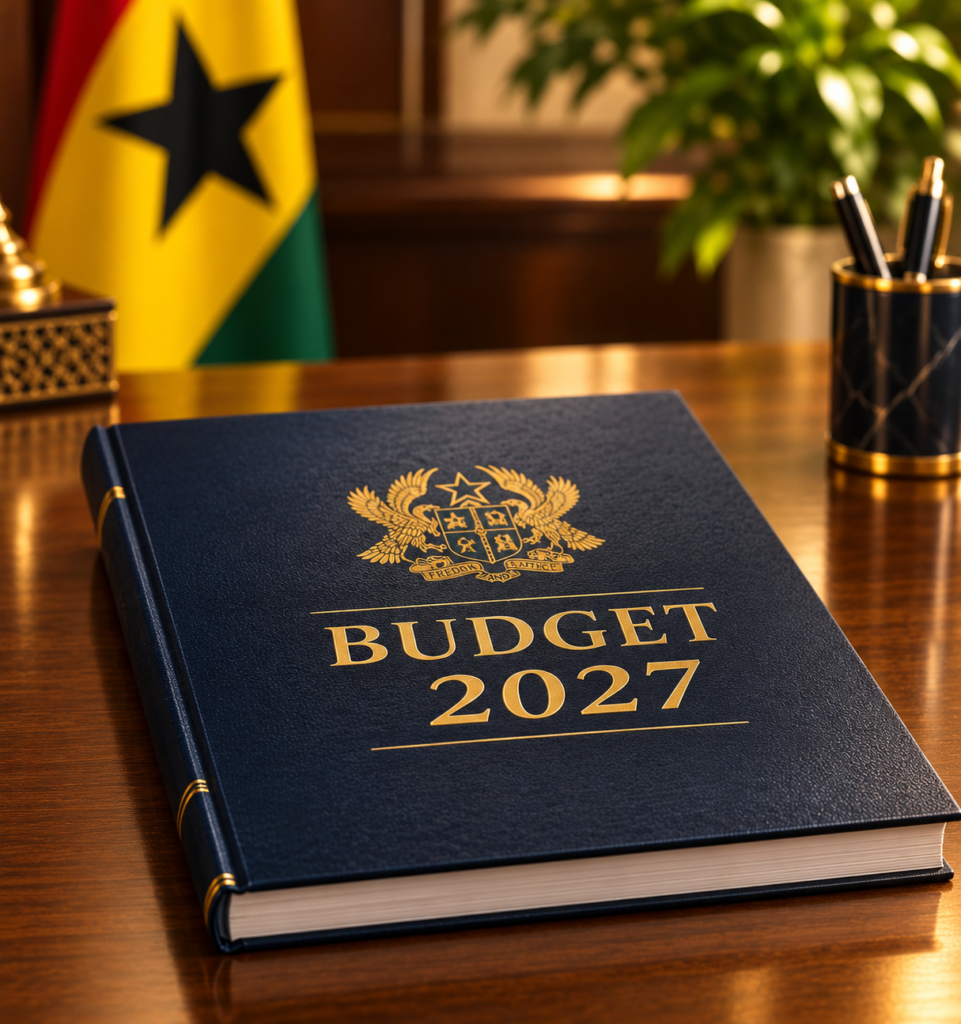
Ghana’s 2027 Budget: The New Normal and What It Means for Investors
Ghana’s 2027 Budget marks a notable shift in fiscal priorities, balancing continued economic stabilization with a renewed focus on investment-led growth. While the government is maintaining fiscal discipline, the budget signals a more expansionary stance through higher capital spending and the launch of a multi-year economic transformation agenda.
Capital Expenditure Takes Centre Stage
One of the most significant developments in the 2027 Budget is the sharp increase in capital expenditure. Total government spending is projected at GHS375.3 billion, with direct capital expenditure almost doubling to GHS100.4 billion from GHS50.9 billion in the 2026 projection. Notably, capital expenditure accounts for approximately 71% of the planned increase in spending, highlighting the government’s intention to prioritize infrastructure and productive investments over recurrent expenditure.
The government is targeting:
- Real GDP growth of at least 5.2%
- End-year inflation of 8.0%
- Gross reserves of at least six months of import cover
- An overall cash deficit of 3.6% of GDP
Although the primary surplus target declines to 0.5% of GDP from 1.5% in 2026, authorities expect stronger revenue performance and targeted investments to support medium-term growth.
The US$10 Billion New Economy Programme
A major highlight of the budget is the launch of the US$10 billion New Economy Programme, which will run from 2027 to 2030 and seeks to accelerate industrialisation, value addition, and export diversification.
The programme focuses on seven strategic sectors:
- Commercial agriculture
- Energy infrastructure
- Critical minerals
- Tourism and creative industries
- Textiles and garments
- Pharmaceuticals
- Technology and digital infrastructure
Agriculture, energy, and minerals alone account for approximately 65% of the programme allocation, underscoring government efforts to strengthen productive capacity and boost domestic value addition.
New Trade and Procurement Policies Could Benefit Local Businesses
The budget also introduces a series of trade and procurement reforms designed to support local production.
Key proposals include:
- Linking rice import licences to purchases from local farmers and millers
- Increasing local cocoa processing requirements
- Expanding local refining and processing of minerals
- Greater local content requirements in public procurement
- Incentives for Ghanaian food, textile, pharmaceutical, and manufacturing firms
These measures could create new opportunities for domestic producers by boosting government orders and encouraging import substitution. However, implementation will be critical to ensure local capacity can meet demand without creating supply bottlenecks.
Implications for the Bond Market
For fixed-income investors, financing requirements remain a key area of focus.
The government plans GHS85.0 billion in net domestic financing in 2027, up from GHS70.1 billion projected for 2026. Much of the increase reflects higher external debt repayments rather than significantly higher domestic spending.
At the same time, the GHS29 billion early redemption offer on Domestic Debt Exchange Programme bonds could inject liquidity into the market as bondholders receive cash for reinvestment. This dynamic may help support demand for government securities and limit excessive upward pressure on yields.
While additional bond issuance is expected, strong investor demand and ample liquidity could help contain yield increases, particularly at the medium and long end of the curve.
What the Budget Means for Equities
The budget presents mixed but largely constructive implications for listed equities.
Banks could benefit from continued private-sector credit growth even as Treasury yields remain lower than historical levels. Institutions with strong low-cost deposits and improving asset quality may be better positioned to defend margins in a lower-rate environment.
Consumer and industrial companies stand to gain from procurement reforms and increased local sourcing requirements, particularly firms operating in food processing, pharmaceuticals, textiles, and manufacturing.
Meanwhile, exporters and commodity-linked businesses could continue to benefit from strong gold exports, which remain a major source of foreign exchange support for the cedi.
Key Risks to Watch
Despite the positive outlook, several risks remain.
The fiscal framework assumes stronger revenue mobilisation, lower energy sector support costs, and timely implementation of key reforms. Weak tax collection, project delays, or rising energy-sector obligations could increase borrowing requirements and place upward pressure on interest rates.
Success will ultimately depend on execution, particularly regarding infrastructure delivery, industrial projects, and measures aimed at boosting domestic production.
Outlook
Ghana’s 2027 Budget reflects a transition from stabilization toward growth and economic transformation. The combination of higher capital expenditure, a US$10 billion development programme, and targeted support for local production creates opportunities across fixed income and equities.
For investors, the near-term market response is likely to be driven by domestic borrowing requirements, bond redemptions, and liquidity conditions. Over the longer term, the success of the budget will depend on whether increased investment translates into stronger economic growth, job creation, and sustainable fiscal outcomes.