Economic Insight | MPC Update
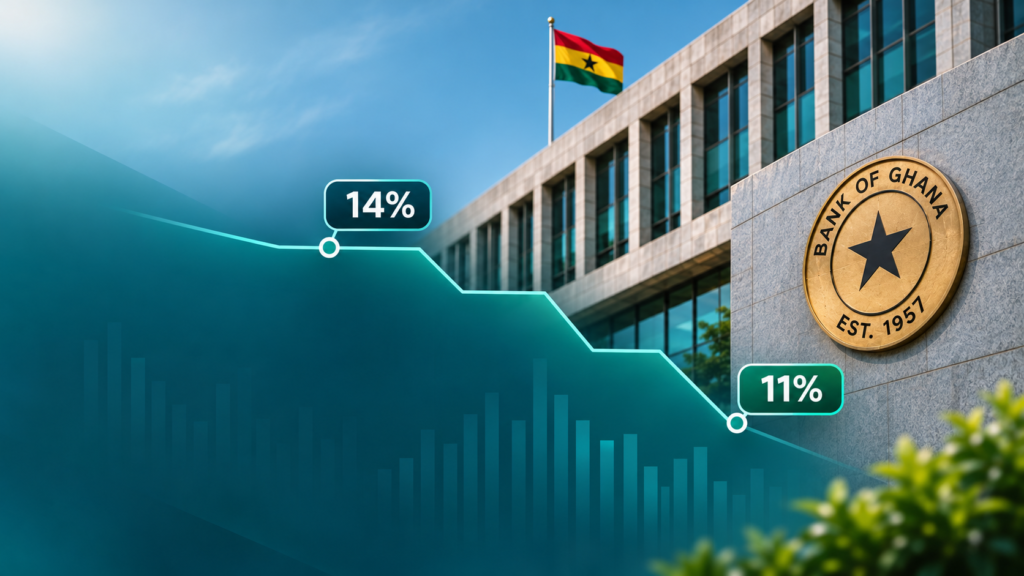
Bank of Ghana Cuts Policy Rate to 11% as Focus Shifts to Policy Transmission
The Bank of Ghana’s Monetary Policy Committee (MPC) reduced the Monetary Policy Rate (MPR) by 300 basis points to 11.0%, a move that signals a realignment of monetary policy with prevailing market conditions rather than the start of a fresh easing cycle.
The decision was accompanied by significant changes to the monetary policy framework. The central bank replaced the 14-day Open Market Operations instrument with a 7-day instrument and narrowed the policy corridor from MPR ±400bps to MPR ±100bps. Importantly, while the upper bound of the corridor fell sharply, the lower bound remains at 10.0%, suggesting limited impact on overnight market rates that were already trading near that level.
We view the adjustment primarily as an effort to improve policy transmission and restore the MPR’s effectiveness as a policy anchor. With the policy rate now closer to prevailing market funding conditions, future monetary policy decisions are likely to transmit more clearly through the financial system.
Inflation Remains Contained but Underlying Pressures Are Rising
Headline inflation increased to 5.5% in October 2026, driven largely by non-food inflation, which accelerated to 7.9%, while food inflation slowed further to 2.8%. Core inflation also edged higher to 5.2%, pointing to gradually strengthening underlying price pressures.
Utility tariff adjustments, energy costs, and potential weather-related disruptions to food supply remain key upside risks to inflation. However, inflation continues to remain relatively low by historical standards and below the Bank of Ghana’s target ceiling.
Economic Activity Continues to Strengthen
Economic growth indicators remain encouraging. The Composite Index of Economic Activity (CIEA) recorded annual growth of 17.7% in September, marking its strongest performance in 2026. Growth has been supported by expanding private sector credit, stronger exports, tourism activity, and construction sector performance.
Private sector credit growth remained robust, increasing 37.2% year-on-year in nominal terms and 30.0% in real terms in October. At the same time, consumer confidence weakened, suggesting that economic activity is being driven more by investment and credit expansion than household spending.
What the Decision Means for Markets
The most immediate impact of the lower policy rate is likely to be seen in bank lending rates rather than Treasury bill yields. Since the Ghana Reference Rate incorporates the MPR, lower policy rates should gradually place downward pressure on borrowing costs across the economy.
Meanwhile, money market yields remain compressed. The 91-day Treasury bill yield declined to 4.62%, below the inflation rate of 5.5%, while the 364-day Treasury bill yield fell to 9.74%. Longer-dated government bond yields, however, continue to hover around 15%, reflecting fiscal financing needs and duration risk premiums.
Outlook
We expect the MPC to maintain the policy rate at 11.0% at its January 2027 meeting. While inflation remains relatively contained, rising non-food inflation, reserve rebuilding requirements, and exchange rate considerations reduce the likelihood of another near-term rate cut.
For investors, medium- and long-dated bonds continue to offer more attractive risk-adjusted returns than short-term instruments. Within equities, lower lending rates could support companies with significant borrowing needs, while banks with strong low-cost deposits, sound asset quality, and sustainable dividend policies are likely to remain well-positioned in a lower-rate environment.
Overall, the MPC’s latest decision reinforces Ghana’s transition into a lower-rate environment, with the focus now shifting from monetary tightening to ensuring effective policy transmission while maintaining macroeconomic stability.